
IndiTherm achieves Euroclass B fire classification in tested timber frame build-up
We’re pleased to share a major milestone for IndiTherm natural fibre insulation.
Following independent fire testing, IndiTherm has achieved a Euroclass B-s1, d0 reaction to fire classification when used as part of a tested timber frame build-up with a plasterboard lining in accordance with EN 13823 (Single Burning Item).
This is an important step forward for natural fibre insulation, showing that low-impact materials can deliver strong, reliable fire performance when used in real building systems.
Independently tested by leading fire experts
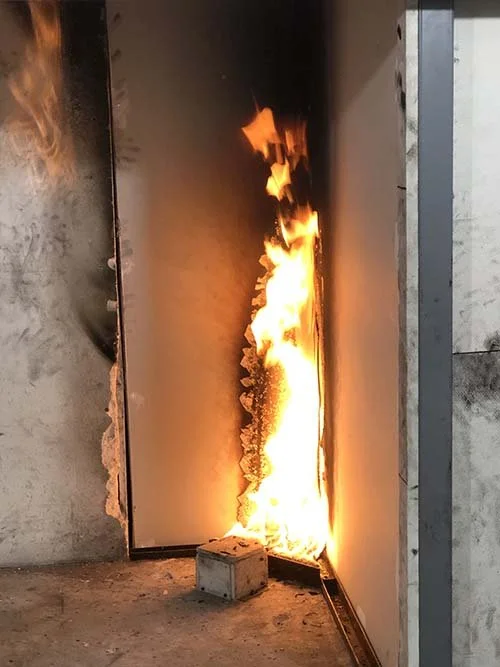
Fire testing was carried out by Warringtonfire using the Single Burning Item (SBI) method – a test that assesses how products behave when exposed to fire.
The SBI test can be used to assess either individual materials or full construction systems. In this case, testing was carried out on a complete build-up, allowing performance to be evaluated in a way that reflects real-world use.
The results confirm that IndiTherm achieves:
Reaction to Fire: Euroclass B (limited contribution to fire)
Smoke emissions: s1 (lowest smoke production)
Flaming droplets: d0 (no flaming droplets observed
What was tested
The classification is based on a complete system designed to reflect typical construction. This included a plasterboard lining with sealed joints, a vapour control layer, IndiTherm insulation installed between timber studs, and OSB substrate.
This is important, because fire performance depends on how materials work together. The result shows how IndiTherm performs in practice, as part of a full wall build-up.


Designed to perform safely in real buildings
In real applications, IndiTherm is always used as part of a wider construction system, and the fire classification reflects this.
To achieve the declared performance, the insulation must be
Be fully enclosed by a fire-resistant lining board manufactured in accordance with BS EN 520
Have fully sealed joints
Be supported by suitable timber studs or battens
These are standard details in timber frame construction and form part of the tested build-up.
When installed correctly, the system provides predictable fire behaviour, low smoke production, and controlled performance in line with modern building requirements.
In-house fire testing
Alongside independent third-party testing, we carry out regular in-house fire testing as part of ongoing product development and quality assurance in accordance with EN ISO 11925-2.
This work helps us better understand flame spread behaviour, fire-retardant performance, and ensure consistency across production batches. It allows us to continually improve the product while maintaining confidence in its performance.
While this internal testing is an important part of our process, independently accredited testing remains the basis for formal fire classification.

A big step forward for natural fibre insulation
Achieving Euroclass B-s1, d0 in a tested wall system is a significant milestone - not just for IndiTherm, but for the wider adoption of bio-based materials in construction.
It demonstrates that natural fibre insulation can play a role in high-performance building systems, delivering strong fire performance alongside the environmental benefits designers are increasingly looking for.
Want to Know More?
Speak to our technical team about suitable applications.
Fire performance - questions and answers
-
Fire testing was carried out by Warringtonfire, an independent, UKAS-accredited fire testing and certification body.
Testing was conducted using the Single Burning Item (SBI) method (EN 13823), alongside ignitability testing to EN ISO 11925-2, with classification to EN 13501-1.
The testing was carried out on a complete wall system, reflecting how the product is used in practice. -
Yes. Like many insulation materials, IndiTherm must be used as part of a complete construction system.
To achieve the declared fire performance, the insulation must be:Fully enclosed by a fire-resistant lining board manufactured in accordance with BS EN 520
Installed with sealed joint
Supported by appropriate timber framing
These requirements reflect the tested system used to achieve the Euroclass B classification. -
Smoke is one of the greatest risks in a fire.
Achieving s1 (lowest smoke production) helps:Maintain visibility
Improve evacuation conditions
Reduce inhalation hazards